


To set up an employee clock-in clock-out system, you need three things: a way for employees to punch in (an app, a physical scanner, or a phone call), a place those punches land automatically as a time card, and rules for rounding, overtime, and job costing that turn those time cards into payroll. Chronotek Pro handles all three in one system, so you can go from signup to your first clocked-in shift the same day.
Are You Looking for the Best Attendance Tracking System for Your Employees?
Using our employee time-tracking software, Chronotek Pro offers three easy ways to clock in and out. It’s simple for employees to use and connects seamlessly with our reporting tools, so you can always stay on top of your jobs and budget.
Do you want to ensure that your employees are always at the job site when clocking in?
Here’s how to start tracking time in three easy steps with Chronotek Pro.
-
Sign up for your 30-day free trial. With no contracts, setup fees, or obligations, our free trial is the perfect way to see how much of an impact Chronotek Pro can make on your business and budget.
-
Set up employee accounts. Ensure each employee is signed up and connected to the system so that they can start clocking in and out smoothly.
-
Start tracking! Now that your employees are ready to track their time, you can focus on running your business.
Choose the Best Clock-in and Clock-Out Options for Your Employees
Chronotek Pro offers three ways for your employees to track their time. Choose the most convenient option, and Pro will automatically track their time.
Clock In with the GPS Time Clock App
The Chronotek Pro mobile app is designed to help employees easily maneuver throughout their workday. Employees can use the app to clock in and out quickly and view personal time cards and schedules to stay in touch with daily activities. They can also send and receive messages from management to guarantee that essential details are communicated. The GPS time clock app uses an internal, cloud-based timer for tracking time to prevent a drained mobile phone battery, and cell data usage is minimal.
Clock In By Scanning TimeTiles™
TimeTiles™ are compact tiles that you affix at worksites. Employees scan them to clock in, ensuring everyone's presence. Together with GPS tracking, Pro alerts you when employees on the clock leave the geofence job site area.
Clock In By Calling
Your employees can create time cards by calling the Chronotek Pro clock-in phone number from any phone. They simply enter their employee access code and a shift pin to clock in and out. Upon calling the clock-in phone number, the first prompt is spoken in English, followed by Spanish. The remainder of the call is in the person's set language. Anyone can make a phone call to clock in. This is the no-excuse clock-in method.
View Live-Streaming Data To Control Labor Hours and Monitor Overtime
Know exactly where your budget sits with our live reporting tools. Chronotek Pro’s software lets you create and monitor job budgets and schedules in real-time. View total hours by day, week, and pay period. And the special sauce? See your job budgets forecasted into the future so you can make easy scheduling changes to stay on track. It's the best way to track and avoid future overtime.
How does an employee clock-in system work?
Every clock-in system follows the same basic loop: an employee starts a shift by creating a timestamped entry, that entry becomes part of a digital time card, and the system totals the hours for payroll and job costing once the shift ends. What separates a good system from a spreadsheet is what happens around that timestamp. A GPS-enabled clock-in also records where the employee was standing, so you know they were actually on-site instead of clocking in from home or a parking lot. Pair that with schedules, and the system can flag late arrivals and no-shows before you'd otherwise notice.
What do you need to set up a clock-in clock-out system?
Setting up a system comes down to a handful of decisions, not a big technical project:
-
Pick your clock-in method(s). Most service businesses use a mix: the mobile app for employees with smartphones, TimeTiles™ for a fixed job site, and a phone-in option for anyone without a smartphone.
-
Create employee profiles. Each employee needs an account tied to their pay rate, job assignments, and, if applicable, contractor vs. employee status.
-
Set up your jobs and schedules. Attaching jobs to schedules lets the system predict labor costs and warn you about overtime before it happens, instead of after the pay period closes.
-
Decide your rounding and overtime rules. Know how punches will be rounded and at what hour threshold overtime kicks in before you go live.
-
Connect payroll. Link the system to your payroll and HR workflow so time cards flow straight into the export your payroll service already uses.
How do you handle time card rounding and overtime when setting up your system?
If you round punches to make payroll easier, the rounding has to follow the Department of Labor's rule: time from 1 to 7 minutes may be rounded down, and time from 8 to 14 minutes must be rounded up to the nearest quarter hour, and it can never be structured to consistently shave time off what employees actually worked. See our 7-minute rounding rule guide for the full breakdown. On overtime, you can adjust the number of hours that trigger 1.5x and 2.0x pay at the master level of your account, or turn overtime calculation off entirely for contractors, which is useful if your state has overtime rules beyond the standard 40-hour work week.
What if some employees don't have a smartphone?
That's not a problem. Employees without a smartphone can clock in by calling a toll-free number from any cell phone or a job site landline. Calls from cell phones won't carry GPS data, but a call from a landline job site phone reports the caller ID, which verifies the employee is on-site. Either way, the dial-in option supports English and Spanish prompts, so language isn't a barrier.
How do you stop buddy punching when setting up your system?
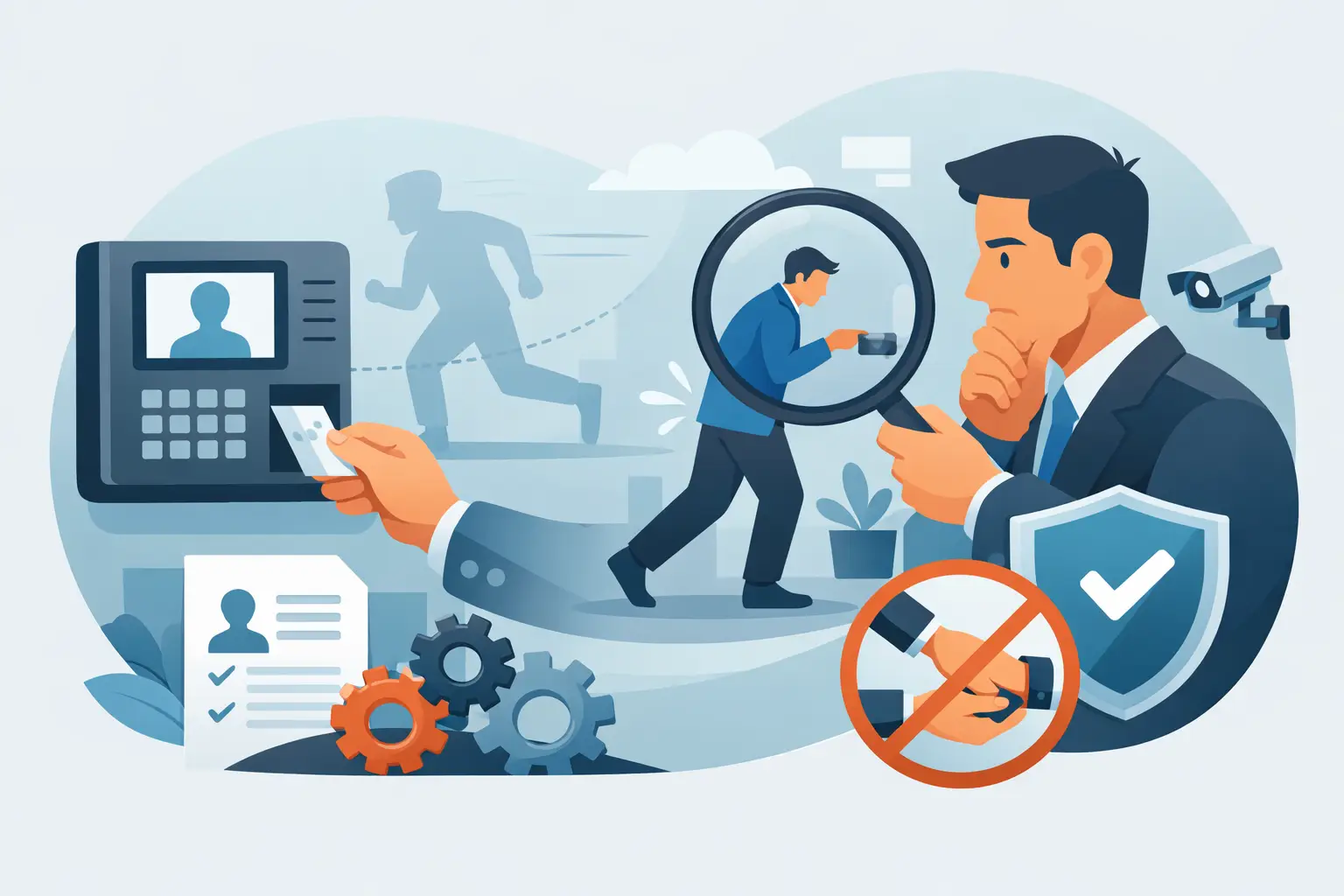
Buddy punching, one employee clocking in for another, is one of the first problems a new clock-in system should close off. GPS geofencing flags whether the phone doing the clocking is actually at the job site, and TimeTiles™ close the loop further: employees must physically tap an NFC tile installed at the site, which can't be copied or scanned remotely the way a QR code can. The system also monitors the geofence continuously for the whole shift, not just at clock-in, and alerts supervisors immediately if someone leaves while still on the clock. For more prevention tactics, see how to stop buddy punching.
Frequently Asked Questions
How long does it take to set up an employee clock-in system?
Most businesses can add a handful of employees and start clocking in the same day. It's smart to start with 3-5 employees in one building to pilot the system before rolling it out company-wide, so you can confirm the setup works the way you expect before adding your full team.
Do employees need a smartphone to clock in?
No. Employees without a smartphone can clock in by calling a toll-free number from any cell phone or job site landline, entering an access code and shift pin. The system supports English and Spanish voice prompts, so a missing smartphone or a language barrier doesn't stop anyone from clocking in accurately.
Can I require employees to clock in only from the job site?
Yes. GPS geofencing checks that an employee is physically at the job site when they clock in, and supervisors get an alert if someone leaves the geofence while still on the clock. TimeTiles™ add a second layer by requiring an on-site NFC tap, so location can be verified two independent ways.
How do I set overtime rules when I set up my system?
You set the number of hours that trigger time-and-a-half and double-time pay at the master level of your account, which lets you match your state's overtime rules if they go beyond the standard 40-hour work week. Overtime can also be turned off entirely for contractors, since it should only apply to employees.
Is there a free trial for setting up a clock-in clock-out system?
Yes. Chronotek Pro offers a 30-day free trial with no contract, setup fees, or obligations, so you can test clock-in methods, scheduling, and reporting with your real team before committing.
Can I change an employee's time card after they clock in?
Yes, but only for legitimate reasons like correcting a missed punch or a system error, not to shave worked time off a paycheck. The Fair Labor Standards Act requires accurate records of hours actually worked, and unlawful edits can carry serious back-pay and penalty exposure. See time card mismanagement for the full rules.