

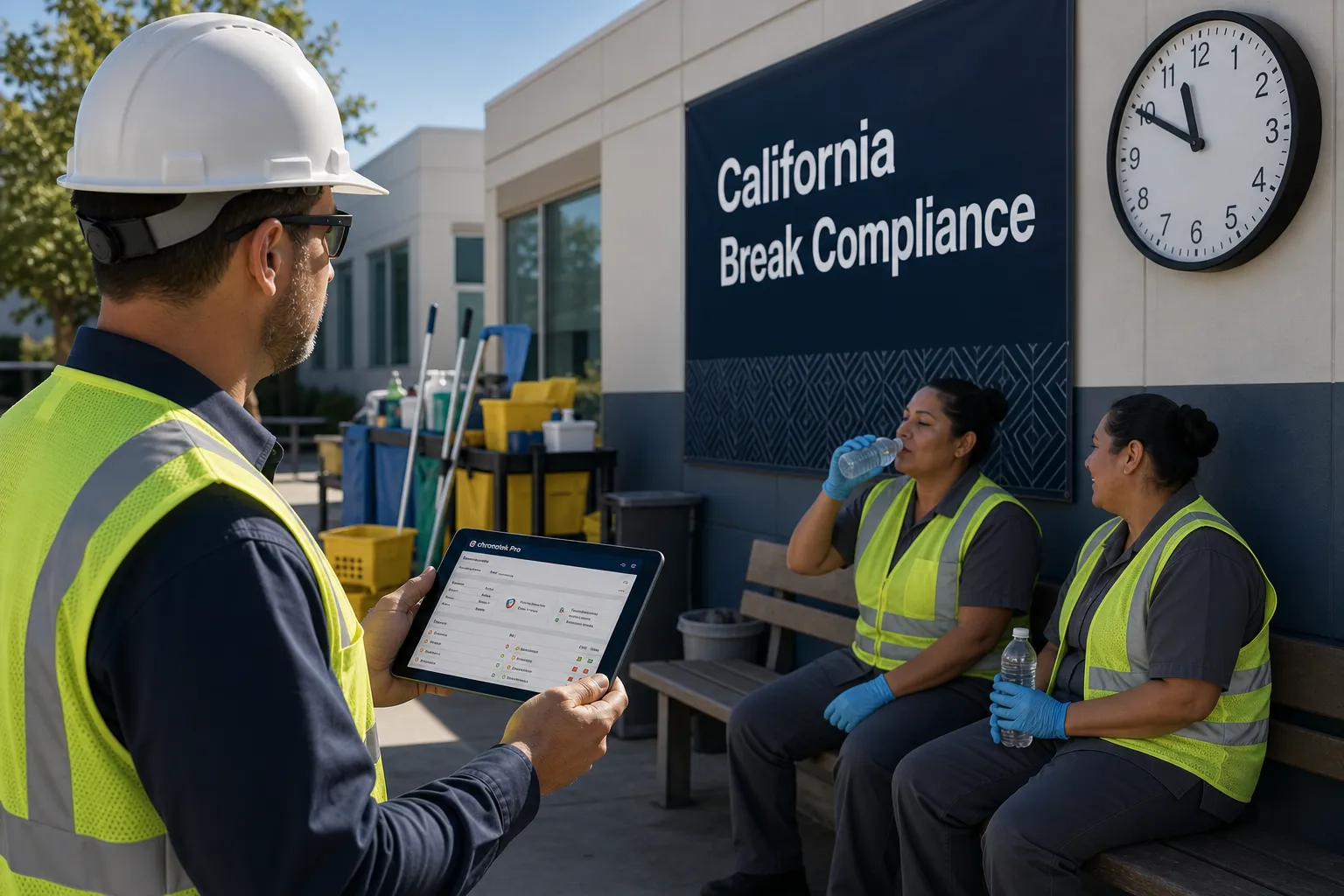


When it comes to workplace regulations, California sets a high bar—especially regarding employee break rights. While meal breaks often get the most attention, rest break regulations are equally important and frequently misunderstood by employers. This article continues our series on California Wage and Hour Compliance Guide for Employers focusing on the intricacies of rest break regulations to ensure your business remains compliant with current standards.
Failing to provide proper rest periods can lead to costly penalties, PAGA claims (Private Attorneys General Act lawsuits), and unhappy employees. In this article, we'll clarify California's rest break laws, outline employer responsibilities, and share best practices to maintain workplace compliance in California.
Top 3 Takeaways for California Employers
-
Rest Break Requirements Are Non-Negotiable: California employers must authorize and permit a paid 10-minute rest break for every four hours worked or major fraction thereof (unless the total workday is under 3.5 hours). Employees must be completely relieved of all duties. Employers cannot use a waiver to avoid providing required breaks, but employees may voluntarily choose not to take a break that was genuinely authorized and permitted.
-
Premium Pay Must Be Calculated Correctly: When required rest breaks are not provided, employers owe one additional hour at the employee's regular rate of compensation (including applicable nondiscretionary bonuses and commissions) per workday, not per missed rest break, as established in Ferra v. Loews Hollywood Hotel. A separate meal-period premium may also be due for a meal-period violation on the same day.
-
Documentation Is Your Best Defense: Though not explicitly required by law, maintaining records of rest break policies and compliance efforts provides crucial protection against potential claims and the significant financial penalties they can trigger.
What Are California's Rest Break Rules for Employers?
 Under California Labor Code Section 226.7 and Industrial Welfare Commission (IWC) Wage Orders, employers must authorize and permit non-exempt employees to take paid, uninterrupted rest breaks:
-
Must be paid and counted as time worked
-
Employers cannot require employees to waive required rest breaks; employees may voluntarily skip an authorized and permitted break without employer coercion
-
Employees must be relieved of all duties during the break
-
Employers cannot require employees to be on-call, monitor work communications, or stay at their workstation
-
If an employer interrupts a rest break and fails to provide a compliant rest period, the employee is entitled to premium pay
Rest Break Schedule Requirements
You must authorize and permit rest breaks based on total hours worked in the day according to California rest break law:
-
Less than 3.5 hours: No rest break required
-
3.5 through 6 hours: One 10-minute rest break
-
More than 6 through 10 hours: Two 10-minute rest breaks
-
More than 10 through 14 hours: Three 10-minute rest breaks
California employer rest break guidelines state that rest breaks should be provided in the middle of each work period "insofar as practicable." While this allows some flexibility, best practice is to schedule breaks near the midpoint of each four-hour work segment whenever possible.
Common California Rest Break Compliance Pitfalls
 1. Misunderstanding "Major Fraction Thereof"
Under California wage laws (Brinker Rest. Corp. v. Superior Court of San Diego County), the phrase "four hours or major fraction thereof" means that if an employee works more than two hours beyond a complete four-hour period, another break is required (subject to the exception for total workdays under 3.5 hours).
For example, an employee working 6.5 hours must be authorized and permitted two 10-minute rest breaks, not just one.
2. Restricting Movement During Rest Breaks
Employees cannot be required to stay at their workstation or on the premises during rest breaks. They must be relieved of employer control over how they spend their break time; in practice, a 10-minute break limits how far an employee can travel and return on time.
3. Implementing "Use It or Lose It" Policies
Employers cannot implement policies that prevent employees from taking required rest breaks after an impracticable scheduled time. Rest breaks must be genuinely authorized and permitted, not merely listed on a schedule. If workload or pressure prevents an employee from taking a break, the employer is still liable; an employee's uncoerced choice not to take a provided break is different.
4. Avoiding On-Call Rest Breaks
Employees must be completely relieved of duties during rest breaks. If they are required to remain available for calls, monitor work emails, or be ready to resume work at a moment's notice, the break is non-compliant. (Augustus v. ABM Security Services - 2016)
5. Failing to Pay Premium Pay
If you fail to provide a compliant rest break, you must pay the affected employee one additional hour of pay at their regular rate of compensation (Ferra v. Loews Hollywood Hotel, LLC) for each workday a violation occurs, not for each missed rest break. A separate one-hour premium may be owed for a meal-period violation on that same workday. "Regular rate of compensation" includes applicable nondiscretionary commissions, bonuses, and other remuneration, not just hourly wages.
Example Calculation:
-
An employee earns $20/hour plus a $200 weekly non-discretionary bonus.
-
If they work 40 hours in a week, their regular rate of pay is: ((40 × $20) + $200) ÷ 40 = $25/hr
-
If a required rest break was not provided on a workday, the rest-period premium is $25 for that day, not $20 or $25 per missed rest break.
In Naranjo v. Spectrum Security Services (2022), the California Supreme Court held that unpaid break premiums are wages that must be reported on wage statements and can support waiting-time penalties for willful failure to pay at termination and wage-statement penalties for knowing and intentional noncompliance. Naranjo (2024) clarified that an objectively reasonable, good-faith belief that premiums were not owed can defeat those penalty claims; they are not automatic whenever a premium is unpaid. Employers should report premiums owed accurately and pay them when due.
6 - Using Pay Systems That Discourage Rest Breaks
Employers must ensure their pay systems don’t discourage rest breaks. In Bluford v. Safeway Inc. (2013), the court ruled that Safeway’s pay structure, which didn’t separately pay truck drivers for breaks, made them less likely to take breaks. Employers using piece-rate, commission, or production-based pay must pay separately for rest breaks to comply with the law.
Rest Facilities Requirement for California Businesses
California employment law states that employers must provide suitable resting facilities in areas separate from toilet rooms. In most workplaces, this means providing a break room, lounge, or designated rest area.
Check the applicable wage order for any specific requirements rather than assuming space constraints create an exemption.
Recordkeeping Recommendations for Rest Break Compliance
While California law does not explicitly require rest break tracking, maintaining timekeeping records is strongly recommended to protect against claims. Best practices include:
-
Documenting rest break policies in the employee handbook
-
Having employees acknowledge rest break policies in writing
-
Training managers to ensure rest breaks are actually taken
-
Using scheduling systems that proactively remind employees of rest breaks
 Industry-Specific Exceptions to California Rest Break Rules
Certain industries have modified rest break rules under Industrial Welfare Commission (IWC) Wage Orders. Examples include:
-
Residential care: Limited exceptions apply to certain employees of 24-hour residential care facilities under Wage Order 5
-
Construction, drilling, logging, and mining: Wage Order 16 allows scheduling adjustments and limited exceptions for certain on-site occupations
-
Motion picture industry: Additional interim rest periods may apply to performers engaged in strenuous physical activity under Wage Order 12
-
Commercial passenger fishing boats: Wage Order 10 includes separate off-duty requirements for crew members on overnight trips
If your industry is regulated by an IWC Wage Order, ensure your rest break policies align with its specific requirements.
How to Comply with California Rest Break Laws
-
Develop Clear Policies – Clearly communicate rest break entitlements and procedures in writing.
-
Schedule Appropriately – Build rest breaks into work schedules and ensure employees can take them.
-
Train Supervisors – Ensure managers enforce rest break policies and do not discourage breaks.
-
Calculate Premium Pay Correctly – Include applicable nondiscretionary bonuses, commissions, and differentials in premium pay calculations.
-
Monitor & Address Chronic Issues – If certain teams consistently miss rest breaks, review workload and staffing.
Final Thoughts
Ensuring rest break compliance isn’t just about avoiding lawsuits—it’s about fostering a fair and productive workplace. Non-compliance can lead to significant financial penalties, including PAGA claims, class action lawsuits, and potentially wage statement violations. Employers who prioritize proper rest break policies benefit from improved employee morale, reduced legal risk, and a healthier work environment.
Don't leave your rest break compliance to chance. Implement a comprehensive timekeeping system that tracks both work hours and paid rest breaks to protect your business from costly violations.
Frequently Asked Questions (FAQs)
1 - How long must a rest break be under California law?
California requires rest breaks to be at least 10 minutes of uninterrupted time during which employees are relieved of all duties. This is a minimum requirement—employers can provide longer breaks if they choose.
2 - Can employees waive their rest breaks if they prefer to keep working?
Employers must genuinely authorize and permit required rest breaks and cannot rely on a blanket waiver or pressure employees to skip them. An employee may voluntarily choose not to take a break that was actually made available without employer interference; this is not an employer waiver of its duty.
3 - What happens if an employee misses a rest break?
If the employer does not provide a required compliant rest break, it owes one additional hour of pay at the employee's regular rate of compensation for that workday, regardless of how many required rest breaks were not provided. A meal-period violation may trigger a separate premium. A freely chosen skipped break after a genuine opportunity to take it does not itself trigger a rest premium.
 4 - Do rest breaks need to be documented?
California law does not explicitly require employers to track rest breaks, but maintaining records is strongly recommended to protect against claims and demonstrate compliance.
5 - Can an employer require employees to stay on-site during rest breaks?
No. Under DLSE guidance citing Augustus, employers cannot require employees to remain on the premises or at their workstations during rest breaks. A 10-minute break does, however, practically limit how far employees can go and return on time.
6 - Are independent contractors entitled to rest breaks?
No, California rest break laws apply only to non-exempt employees. Independent contractors are not covered under these provisions.
7 - Can employers schedule specific times for rest breaks?
Yes, employers can designate times for rest breaks. However, these scheduled times should comply with the requirement that breaks be provided "in the middle of each work period insofar as practicable." Scheduling too early or too late in a work period may not comply.