



Don't you love Google reviews? They're real people giving honest opinions about the products and services you need. Online surveys accomplish this same thing. We conducted one recently to see if we are hitting our target - help small business owners save money on payroll and save time processing payroll hours.
The Two Survey Questions About Handwritten Timesheets
In the spirit of keeping things simple, we asked two questions:
- Have you spent less on labor dollars as a direct result of using Chronotek instead of handwritten timesheets? If so, how much have you saved?
- Compared to using handwritten timesheets, how much time do you save processing payroll hours each pay period with Chronotek?
The Survey Results - Payroll and Admin Time Savings
The Payroll Savings Using an Employee Time Clock App
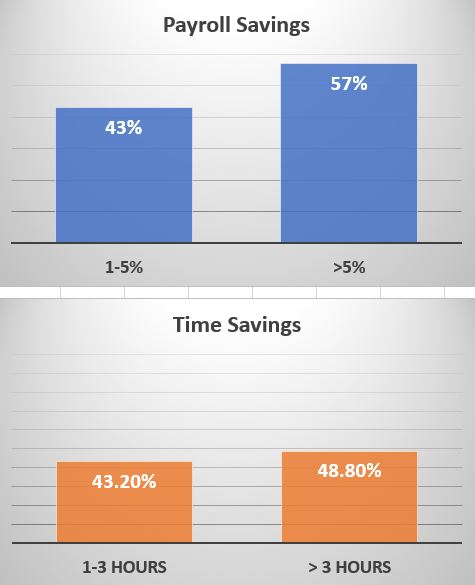
As you can see, 100% of our customers responded that they saved money with our automated employee time tracking system. 43% of the respondents saved 1-5% on labor dollars, and 57% saved more than 5%.
A note about the 57% on the Payroll Savings chart - 20% saved more than 10% on payroll dollars out of that number. These results prove that handwritten time cards are indeed a money trap, which could be a result of employee time theft.
The Admin Time Savings Using An Employee Time Clock App
The chart shows that 43% of our admin customers saved between 1-3 hours on payroll processing time each pay period, and almost 49% saved more than 3 hours.
Our research also discovered that an admin's honest mistakes with handwritten timesheets can be costly. Reading and typing mistakes can cost up to 8% of annual gross payroll, while an admin spends 5-6 minutes per timecard each pay period to process payroll.
What would you do with an extra 3 hours a week?
What Does This Survey Mean to Your Service Company?
Let's illustrate this further with a story about a fictional service company called Top Shelf Cleaning Company. Top Shelf is struggling due to rising labor costs.
Numbers for Top Shelf Cleaning Company:
- 25-employee commercial cleaning business (all part-time employees)
- 20 hours a week at $14 per hour(1)
- $7,000 weekly payroll + FICA and worker's comp.
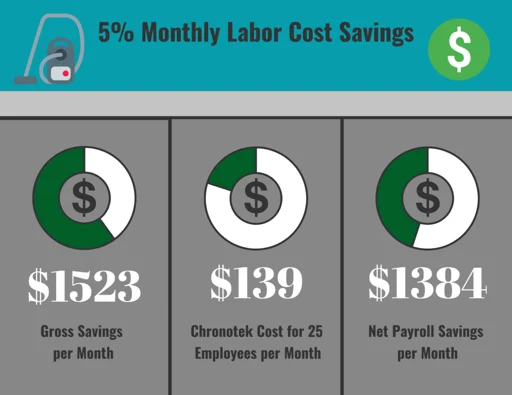
Top Shelf Cleaning Company signs up for our employee GPS time clock system. Based on our survey results, Top Shelf should save at least 5% on labor costs.
What Does a 5% Monthly Labor Cost Savings Mean to Top Shelf?
Are You Ready to Save Time and Money?
Employee time tracking is a relatively straightforward concept. Labor is a service company's highest expense, and accurate timekeeping directly impacts labor costs.
Save money on payroll and save time processing payroll. Small business owners around the country say that they are enjoying these benefits. We verified - it's more than just our feelings :)
Let us help you, also.
Give it a shot for 30 days for free.
How Much Money Do Businesses Actually Save With Automated Time Tracking?
Our survey results are clear: every single respondent, 100% of Chronotek customers surveyed, said they saved money after switching from handwritten timesheets to an automated employee time tracking system. The savings break down like this:
- 43% of respondents saved 1-5% on labor dollars
- 57% saved more than 5% on labor dollars
- Of that 57%, 20% saved more than 10% on payroll dollars
In other words, more than half of the businesses we surveyed saved more than 5% on labor costs simply by replacing handwritten time cards with an automated system, and a full fifth of them saved more than 10%. See how timekeeping works to find out where your own payroll dollars are leaking.
How Much Admin Time Does Automated Payroll Processing Save?
Processing payroll isn't just about labor dollars — it also costs admin time. Our survey found that 43% of admin customers saved between 1-3 hours on payroll processing time each pay period, and almost 49% saved more than 3 hours. That's because handwritten timesheets are error-prone: reading and typing mistakes can cost up to 8% of annual gross payroll, and an admin typically spends 5-6 minutes per timecard each pay period just processing hours by hand.
Multiply 5-6 minutes by every timecard, every pay period, and it's easy to see why almost half of our admin customers got back more than 3 hours a week. An HR and payroll system that automates that math gives your admin team those hours back.
What Does a 5% Payroll Savings Look Like for a Real Cleaning Business?
Go back to our fictional Top Shelf Cleaning Company: a 25-employee commercial cleaning business with all part-time employees working 20 hours a week at $14 per hour, and a $7,000 weekly payroll before FICA and worker's comp. Based on our survey results, Top Shelf should save at least 5% on labor costs after switching to an employee GPS time clock system.
A 5% reduction on a $7,000 weekly payroll adds up week after week, month after month — real money that a 25-person part-time crew can put back into the business instead of losing it to handwritten timecard errors.
Frequently Asked Questions
How much can a cleaning business save on payroll by switching from handwritten timesheets?
In our survey, 100% of Chronotek customers reported saving money after switching from handwritten timesheets to an automated employee time tracking system. 43% saved 1-5% on labor dollars, 57% saved more than 5%, and 20% of that 57% saved more than 10% on payroll dollars.
How much admin time does automated payroll processing save each pay period?
Quite a bit. 43% of our admin customers saved 1-3 hours on payroll processing time each pay period, and almost 49% saved more than 3 hours. That's because handwritten timesheets can cost up to 8% of annual gross payroll in reading and typing mistakes, on top of the 5-6 minutes an admin spends processing each timecard by hand — costs that HR and payroll automation eliminates.
What would a 5% payroll savings mean for a 25-employee cleaning company?
Using our fictional Top Shelf Cleaning Company as an example — a 25-employee commercial cleaning business with part-time staff working 20 hours a week at $14 per hour and a $7,000 weekly payroll — a 5% labor cost reduction, the savings level our survey respondents typically reported, compounds significantly over a year of payroll cycles. See how a GPS time clock system gets you there.
Is handwritten timekeeping really that much more expensive than an app?
Yes. Our research found that handwritten timesheets lead to reading and typing mistakes that can cost up to 8% of annual gross payroll, plus 5-6 minutes of extra admin time per timecard every pay period. Switching to an automated time clock system removes both the labor-cost leakage and the admin burden survey respondents described.
Do I need to sign a contract to try Chronotek's time clock system?
No. Chronotek Pro offers a free 30-day trial, so small business owners can test the time tracking and payroll savings for themselves before committing to anything. Give it a shot for 30 days, see how much you save on labor dollars and admin time, and decide from there.
Does the payroll savings estimate include FICA and worker's comp costs?
Not directly. In the Top Shelf Cleaning Company example, the $7,000 weekly payroll figure is before FICA and worker's comp are added, and the 5% labor cost savings applies to the underlying wages tracked through GPS time clock data. Reducing wage errors still lowers the base your payroll taxes and insurance premiums are calculated from.
Footnotes:
- https://www.ziprecruiter.com/Salaries/Cleaner-Salary-per-Hour