

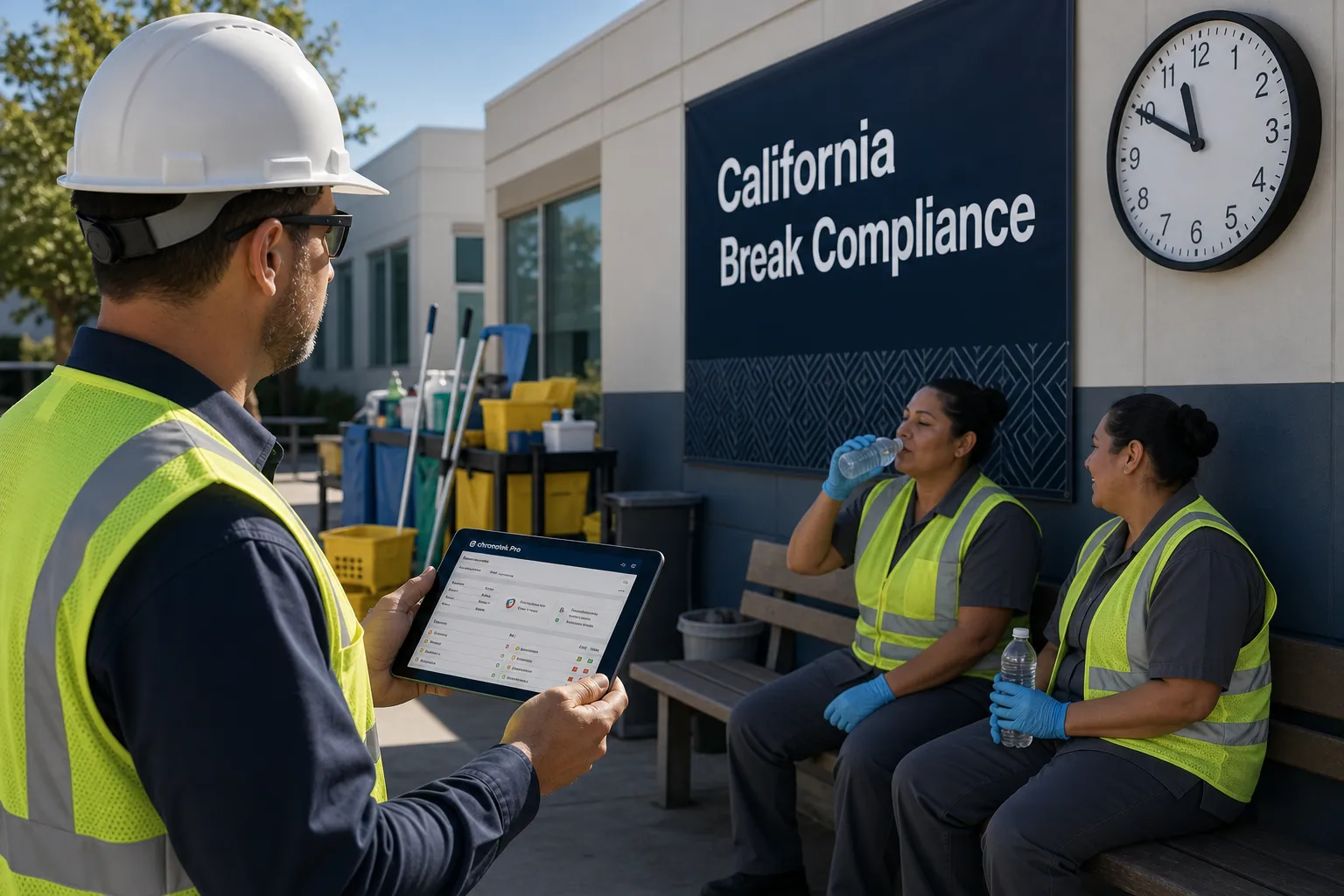


California employers generally must provide timely, duty-free meal periods and keep accurate records. The California Labor Commissioner's meal-period guidance explains the rules and the pay owed when an employer fails to provide a required break. Meal periods are one part of wage-and-hour compliance; see our California Wage and Hour Compliance Guide for Employers for broader context.
This guide covers the general rules for covered employees. Industry-specific wage orders and exceptions can change the analysis; this is general information, not legal advice.
Top 3 Takeaways
For a work period over five hours, provide a 30-minute meal period beginning no later than the end of the fifth hour.
 For work over ten hours, provide a second meal period beginning no later than the end of the tenth hour. Limited waivers require mutual consent.
A missed, short, late, or otherwise noncompliant meal period can require one additional hour of pay at the regular rate for that workday, not one hour for each missed meal period. A separate rest-period premium may also be owed if a required rest period was not provided.
Clear policies, training, accurate time records, and prompt review of exceptions help employers identify and address problems.
Table of Contents:
Your Legal Obligations for Meal Breaks
Under Labor Code section 512, generally provide:
A first meal period of at least 30 minutes when an employee works more than five hours in a workday.
A second meal period of at least 30 minutes when an employee works more than ten hours in a workday.
Important Meal Break Timing Rules:
The first meal period must begin no later than the end of the fifth hour of work.
The second meal period must begin no later than the end of the tenth hour of work.
For example, if an employee starts at 8:00 a.m., a required first meal period must begin by 1:00 p.m. Limited waivers and industry-specific rules may apply.
Employee Meal Break Waivers
California allows limited waivers by mutual consent of the employer and employee:
First meal period: It may be waived if the total work period for the day is no more than six hours.
Second meal period: It may be waived if the total hours worked are no more than 12 and the first meal period was not waived.
Important Compliance Requirements for Meal Break Waivers:
Document mutual consent: Written records can help establish that a waiver was actually agreed to, although the general waiver rule does not require a written agreement.
Keep waivers voluntary: Do not pressure employees to waive breaks.
Check applicable rules: Some industries and wage orders have different requirements.
On-Duty Meal Breaks
 An on-duty meal period counts as paid time worked. It is allowed only when the nature of the work objectively prevents relief from all duties and the employer and employee have a written agreement providing for a paid on-duty meal period. The agreement must state that the employee may revoke it in writing at any time. See the DLSE meal-period guidance.
Examples the DLSE identifies as potentially qualifying include a sole worker in a coffee kiosk or all-night convenience store and a security guard alone at a remote site. A job title alone does not establish eligibility; whether the work actually prevents relief matters.
A waiver means no meal period is taken under a permitted mutual-consent exception. An on-duty meal period is different: the employee remains on duty and must be paid.
 Your Responsibilities During Meal Breaks
For an ordinary off-duty meal period, relieve employees of all duties, relinquish control over their activities, allow them a reasonable opportunity to take an uninterrupted 30-minute break, and do not impede or discourage breaks. Under DLSE guidance discussing Brinker Restaurant Corp. v. Superior Court, employers must provide the opportunity for a compliant meal period, but need not police breaks to ensure that no work is performed. If an employee freely chooses to work despite bona fide relief, a meal premium is not automatically owed; known or reasonably knowable work must still be paid. Record meal period start and end times and investigate apparent exceptions.
Premium Pay Requirements for Violations
If an employer fails to provide a required compliant meal period, Labor Code section 226.7 requires one additional hour of pay at the employee's regular rate of pay for each workday the meal period is not provided, even if more than one meal period was missed that day. A separate one-hour rest-period premium may also be due for a workday when a required rest period was not provided. The California Supreme Court's decision in Ferra v. Loews Hollywood Hotel, LLC (2021) explains that the regular rate includes applicable nondiscretionary compensation, not just the base hourly rate; this may include nondiscretionary bonuses, commissions, or shift differentials, as applicable.
Record-Keeping Requirements
Maintain accurate time records, including when employees begin and end work and meal periods, split-shift intervals where applicable, and total daily hours worked. Applicable wage orders generally require payroll records to be retained for at least three years and made available for inspection; check the relevant wage order.
As discussed in our California Wage and Hour Compliance Guide for Employers, even a 29-minute recorded meal period is short of 30 minutes. Under Donohue v. AMN Services, LLC (2021), records showing a short, late, or missed meal period raise a rebuttable presumption of a violation; examine the facts and pay any premium owed. Meal punches cannot be rounded to make a noncompliant period appear compliant.
Potential Penalties for Non-Compliance
Consequences may include:
One meal-period premium at the regular rate per workday of meal-period violation, and potentially a separate rest-period premium if a rest period was not provided.
Unpaid wages for work performed during meal periods, where applicable.
Wage claims, litigation (including potentially class or PAGA actions), or Labor Commissioner enforcement, depending on the facts and applicable law.
Possible wage-statement consequences and waiting-time penalties if their separate statutory requirements are met. Waiting-time penalties are not automatic upon termination: they concern willful failure to pay final wages when due, subject to a reasonable good-faith dispute defense. See DLSE waiting-time guidance and the Naranjo decisions below.
Industries with Special Rules
Check the applicable California wage order and any applicable federal rules rather than assuming every worker follows the same schedule:
Healthcare: Special meal-period provisions may apply under Wage Orders 4 and 5.
Transportation: The interaction of state rules and federal rules depends on the work and applicable law.
Motion picture: Wage Order 12 has different meal-period timing.
Collectively bargained workplaces: Statutory exceptions have specific requirements.
Best Practices for Compliance
Practical steps to identify and address potential violations include:
 1 - Implement Clear Policies
Write meal-period policies that explain timing, permitted waivers, on-duty agreements, and how employees can report missed or interrupted breaks.
2 - Train Management and Supervisors
Train managers not to pressure employees to skip breaks and to escalate reported or apparent exceptions.
3 - Create Effective Tracking Systems
Use reliable timekeeping systems to record actual meal-period start and end times without rounding meal punches. Review records regularly for short, late, or missing breaks.
For employees working across multiple job sites, our field-team meal and rest break guide covers how to plan relief coverage, send timely reminders, and review exceptions as they happen.
4 - Document Properly
Retain evidence of mutual waiver consent when applicable and required written on-duty meal agreements.
Offer employees a way to report interrupted or missed breaks, document investigations and corrections accurately, and record any premiums paid. Do not substitute blanket attestations for actual time records.
5 - Audit Regularly
Audit records and practices periodically, correct problems promptly, and seek qualified employment counsel for industry-specific questions.
6 - Pay Premium Pay Promptly
Calculate premiums at the applicable regular rate, pay amounts owed promptly, and report them on wage statements as wages.
Recent Legal Rulings That Impact Meal Break Requirements
Brinker Restaurant Corp. v. Superior Court (2012), discussed by DLSE: Employers must provide a compliant break and not impede it, but need not ensure that an employee performs no work after bona fide relief from duties.
Donohue v. AMN Services, LLC (2021): Meal-period punches cannot be rounded; time records reflecting noncompliant meal periods create a rebuttable presumption of violations.
Naranjo v. Spectrum Security Services, Inc. (2022): Missed-break premiums are wages for purposes of wage statements and statutory final-pay deadlines. Naranjo (2024) held that a reasonable, good-faith belief in wage-statement compliance can defeat the knowing-and-intentional element of statutory wage-statement penalties; a reasonable good-faith dispute over wages due can also preclude willful waiting-time penalties. Neither ruling makes all penalties automatic.
Ferra v. Loews Hollywood Hotel, LLC (2021): Meal and rest premiums use the regular rate, which includes applicable nondiscretionary compensation, rather than simply the base hourly rate.
Wrapping It Up
Provide timely, duty-free meal periods, track actual breaks, investigate apparent exceptions, and pay any wages or premiums owed. For more, see our California compliance tools and guide to California rest break requirements. This overview is informational, not legal advice; seek qualified counsel for a specific situation.
Frequently Asked Questions (FAQs)
What are California's meal break requirements?
Generally, provide a 30-minute meal period when work exceeds five hours and a second 30-minute meal period when work exceeds ten hours. The first must begin no later than the end of the fifth hour, the second no later than the end of the tenth hour, subject to limited waivers and applicable industry rules.
Can employees waive their meal breaks?
Only by mutual consent: the first may be waived if the total work period is no more than six hours; the second may be waived if total hours worked are no more than 12 and the first was not waived. Written documentation of general waiver consent is prudent but not universally required.
What happens if an employee works through a meal break?
If the employer did not provide a required compliant break, one additional hour at the regular rate is due for that workday, not per missed meal period. If an employee freely chooses to work after being genuinely relieved of all duties without employer discouragement, a meal premium is not automatic; known or reasonably knowable work still must be paid.
Are on-duty meal breaks allowed?
Only if the nature of the work prevents relief from all duties and the parties have a written paid on-duty meal agreement stating the employee may revoke it in writing at any time.
How should employers track meal breaks?
Record actual meal start and end times without rounding, review short, late, or missing breaks, and retain relevant waiver and on-duty agreements.
What are the penalties for meal break violations?
A failed required meal period generally requires one hour of premium pay at the regular rate per workday of meal violation; a separate rest-period premium may also apply. Other claims depend on their own requirements. Waiting-time penalties require a willful failure to pay final wages when due and are not automatic at termination.
Are any industries exempt from California's meal break laws?
Specific wage orders and statutes provide different rules or exceptions for some workers, including certain motion-picture, healthcare, transportation, and collectively bargained employees. Check the applicable rule rather than assuming a blanket exemption.