



The 7-minute rule is the Department of Labor’s guideline for rounding employee time clock punches to the nearest quarter hour: minutes 1 through 7 past the quarter-hour mark round down, and minutes 8 through 14 round up. Employers use it to simplify payroll math and speed up time card processing, but the rounding must average out over time and can never be applied in a way that consistently shortchanges employees’ pay under the Fair Labor Standards Act (FLSA).
Are you rounding your employees’ time sheets to make payroll easier, prevent early clock-ins, or even boost employee pay? It’s essential to accurately and legally round time clock punches to protect yourself and your business.
Do you want to ensure that your employees are always at the job site when clocking in?
Rounding Rules to Keep In Mind When Changing Timesheets
1 - Rounded Timesheets Cannot Benefit the Employer
Any time clock rounding adjustments made to the timesheet cannot be used by the employer to save money. For example, if an employer saw a timesheet with a start time of 8:03 and then rounded it to 8:15, the employer would save almost a quarter hour’s pay, even though the employee worked most of the quarter hour and should be compensated accordingly. Be careful with time card manipulation. The Fair Labor Standards Act (FLSA) requires that employers pay for all the time employees work.
2 - Follow the 7-Minute Rule
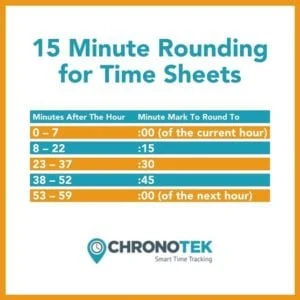
According to the Department of Labor, “Employee time from 1 to 7 minutes may be rounded down, and thus not counted as hours worked, but employee time from 8 to 14 minutes must be rounded up and counted as a quarter hour of work time.” If you want to double-check your timesheet rounding, the chart below breaks down how to round time sheets to the nearest 15-minute mark.
3 - You Cannot Round in Increments Greater Than 15 Minutes
While it’s common to round time sheets to the nearest quarter hour, employers can also round by the 1/10 of an hour (6 minutes) or by 5 minutes. Remember that employers cannot round in increments greater than 15 minutes.
What Is the 7-Minute Rule for Time Clocks?
In practice, the 7-minute rule works off whatever rounding increment you’ve chosen — usually the nearest quarter hour. Picture a shift that’s supposed to start at 8:00. If an employee clocks in at 8:04, that punch falls within the first 7 minutes of the quarter hour, so it rounds down to 8:00. If the same employee clocks in at 8:09, that’s 9 minutes past the mark, which falls in the 8-to-14-minute window, so the punch rounds up to 8:15. The same logic applies to clock-outs: a punch a few minutes early or late gets nudged to the nearest quarter hour rather than paid to the exact minute.
The rule only works fairly when it’s applied consistently to every punch, every day, for every employee. If you round down every late clock-in but never round up an early clock-out, you’re no longer following the 7-minute rule — you’re building a rounding policy that benefits the employer, which the FLSA doesn’t allow.
How Do You Round Employee Time Cards Correctly?
To round a time card correctly, apply the same increment and the same math to every punch on the sheet:
Pick one rounding increment for the whole company — nearest 5 minutes, nearest 6 minutes (one-tenth of an hour), or nearest 15 minutes (quarter hour) — and never exceed 15 minutes.
Compare each punch to the nearest increment mark and use the 7-minute rule (or the equivalent split for a smaller increment) to decide whether it rounds up or down.
Apply the rounding to clock-ins and clock-outs alike, so early arrivals and early departures are treated the same way as late ones.
Check the rounded totals against the actual punches periodically to confirm the policy isn’t quietly favoring the business over time.
If your team still calculates hours by hand, converting the rounded punches into payroll-ready decimals is its own source of errors — our guide on how to convert time clock hours and minutes to decimals walks through the math and the mistakes to watch for.
Why Do Employers Round Time Sheets in the First Place?
Rounding exists because payroll math is easier in clean increments than in a stack of odd punch times. Quarter-hour and decimal-based payroll systems expect entries like 8.00 or 8.25 hours, not 8:03 or 8:09, so rounding lets a payroll administrator process a stack of time cards without hand-converting every single punch. It also smooths out the small, everyday variation in when people actually reach the time clock, so an employee who’s a minute or two early one day and a minute or two late the next isn’t paid a different total for showing up at essentially the same time. Done correctly, rounding is a convenience for both sides of the payroll process, not a way to shave time off anyone’s paycheck. If manual conversion is still part of your process, see our HR and payroll tools for ways to simplify it.
What Happens If You Round Time Sheets Incorrectly?
Rounding becomes a legal problem the moment it stops being neutral. If your rounding policy — intentionally or not — rounds clock-ins up and clock-outs down more often than the reverse, you’re systematically paying employees for less time than they worked, and the FLSA treats that the same as any other unpaid wages. This is closely related to time card manipulation: even if no one is deliberately editing punches, a rounding rule that consistently favors the employer produces the same result as shaving time off a time card by hand. It’s also worth remembering that the FLSA sets a federal floor — some states layer on additional wage and hour requirements, so if you operate in a state with stricter rules, check guidance like our California compliance overview before finalizing a rounding policy.
How Can Automated Time Tracking Simplify Time Rounding?
The easiest way to avoid rounding mistakes is to stop doing the rounding by hand. A GPS time clock app like Chronotek Pro captures the exact clock-in and clock-out time the moment an employee punches in, verifies they’re at the job site, and builds the time card from those exact minutes — so you can skip rounding altogether. There’s no risk of a payroll admin rounding one punch differently than another, and no end-of-week scramble to double-check quarter-hour math across dozens of time cards. Everything shows up already calculated and ready for payroll on a live timekeeping dashboard, so there’s no guessing whether a rounding policy is being applied consistently — the actual worked time is the record.
Tired of Spending Time Manually Adjusting Each Employee Timesheet?
Skip the hassle of rounding employee hours with Chronotek Pro!
Employees can clock in anywhere and on any device. Chronotek Pro eliminates time card waste and helps you avoid problems with the FLSA. Pro is fantastic for your cleaning business, pool company, or security guard company.
Try for free for 30 days.
Frequently Asked Questions
What is the 7-minute rule for rounding time sheets?
The 7-minute rule is a Department of Labor guideline for rounding time clock punches to the nearest quarter hour. Minutes 1 through 7 past the quarter-hour mark may be rounded down and not counted as hours worked, while minutes 8 through 14 must be rounded up and counted as a full quarter hour of work time.
Can employers round time cards in their own favor?
No. The FLSA requires that rounding be neutral over time — it can reduce paid time on some punches and add paid time on others, but it cannot be structured so that, on average, employees are paid for less time than they actually worked. Rounding adjustments can never be used by the employer to save money at employees’ expense.
What increments can you use to round employee time?
Most employers round to the nearest quarter hour (15 minutes), but rounding to the nearest 5 minutes or to the nearest one-tenth of an hour (6 minutes) is also common and legally acceptable. Whatever increment you choose, you cannot round in increments greater than 15 minutes — quarter hour is the largest allowable window.
Do employers have to round time sheets at all?
The Department of Labor guideline says employee time may be rounded — it describes how rounding must work when an employer uses it, while the FLSA still requires pay for all time worked. With an automated time clock that records exact clock-in and clock-out times, you can skip the hassle of rounding entirely and pay from the exact minutes worked.
How does GPS time tracking help with time sheet rounding?
A GPS time clock app like Chronotek Pro records the precise clock-in and clock-out time for every punch, so payroll can run on the exact minutes worked and rounding isn’t needed at all. That removes the manual math that leads to accidental employer-favoring rounding and gives you a digital record of the actual time worked on every shift.
Are time-rounding rules the same in every state?
The FLSA sets the federal baseline described above, but it’s only a floor. States can and do add their own wage and hour requirements on top of federal law, so a rounding policy that’s compliant nationally may still need adjustments in stricter states. Check state-specific guidance, such as our California compliance resources, before rolling out a company-wide policy.