

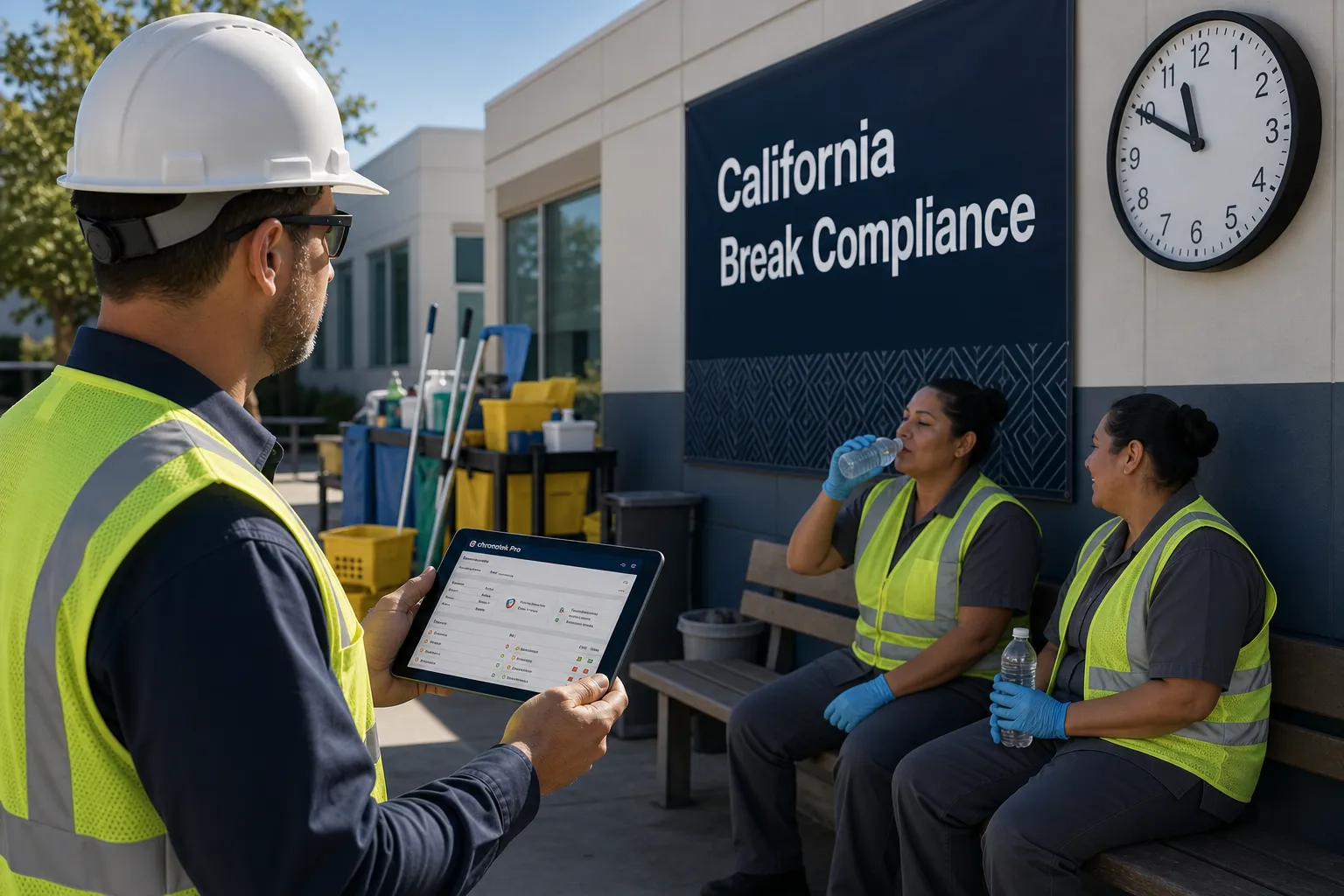


This guide provides general information, not legal advice. Have qualified California employment counsel review rules that depend on your workforce and pay practices.
California wage-and-hour rules affect more than hourly rates: employers must account for hours worked, overtime, meal and rest periods, split shifts, worker classification, and reporting time. This is a general overview, not a substitute for checking the applicable wage order, local ordinance, industry rules, or legal advice about a particular workforce.
Key Takeaways
- California's statewide minimum wage is $16.90 per hour effective January 1, 2026; higher local or industry rates may apply.
- Most nonexempt employees are subject to daily and weekly overtime rules, as well as meal- and rest-period requirements. Exceptions depend on the job and applicable wage order.
- Accurate records of hours worked, breaks, locations, and schedules help employers review payroll, but time-tracking software does not itself establish legal compliance.
Table of Contents
- Overview of California Workplace Laws
- Minimum Wage Requirements
- Overtime Pay Regulations
- Drive Time Pay
- Meal and Rest Breaks
- Split Shift Regulations
- Worker Misclassification
- Reporting Time Pay Rules
- Legal Recourse
- Summary
- Frequently Asked Questions
Overview of California Workplace Laws
Federal law sets a baseline, but California and local rules may provide additional protections. The comparison below is a starting point, not a substitute for the rules applicable to a specific employee.
| Topic | Federal baseline | California general rule |
|---|---|---|
| Minimum wage | $7.25 per hour under federal law. | $16.90 per hour statewide effective January 1, 2026; higher local and industry rates may apply. |
| Overtime | Generally after 40 hours in a workweek for covered nonexempt workers. | Daily and weekly overtime, double time, and seventh-consecutive-day rules for most nonexempt workers, subject to exceptions. |
| Meal and rest periods | Federal law does not generally mandate meal or rest breaks. | Meal periods and paid rest periods generally apply under California rules; timing, waivers, and exceptions matter. |
| Split shifts | No general federal split-shift premium. | An applicable wage order may require additional pay for a qualifying employer-scheduled split shift, with a credit for wages above minimum wage. |
| Reporting time | No general federal reporting-time pay requirement. | Applicable wage orders may require reporting-time pay when an employee reports but is not furnished sufficient work, subject to exceptions. |
See the California Labor Commissioner's 2026 wage announcement and the overtime FAQ for current statewide baselines.
What Is the Minimum Wage in California?
The statewide minimum wage is $16.90 per hour effective January 1, 2026. Employers must check whether a higher city, county, or industry-specific minimum applies where an employee works. Rates and coverage can change; do not assume a single statewide rate covers a mobile workforce. California also has distinct requirements for certain fast-food and health-care workers, so confirm the applicable industry rule rather than using a general rate for every employee.

Exempt Employees
For the standard executive, administrative, and professional overtime exemptions, the 2026 minimum salary threshold is $70,304 per year (twice the state minimum wage for full-time employment). That is only one requirement: the applicable duties test and salary-basis requirements must also be met. Other exemptions have different tests; a job title or salary alone does not establish exempt status.
Time records and work-location information can help payroll teams review applicable rates, but configure and verify pay rules independently; do not assume a time clock automatically applies every local or industry differential.
California's Overtime Laws and How They Differ from Federal Rules
For most California nonexempt employees, the Labor Commissioner's overtime guidance requires one and one-half times the regular rate for hours over eight through 12 in a workday and hours over 40 in a workweek, and for the first eight hours on the seventh consecutive day of work within the employer's established workweek. Double time generally applies after 12 hours in a workday and after eight hours on that seventh consecutive day. Do not count the same hours twice when applying daily and weekly rules. Exemptions, applicable wage orders, and valid alternative workweek schedules may change the result.
The regular rate can include more than base hourly pay, such as shift differentials, commissions, and nondiscretionary bonuses (for example, a promised attendance or production incentive). A genuinely discretionary bonus, for which the employer retains discretion over both whether to pay and the amount until near the time of payment, may be excluded under the applicable rules. A label alone does not make a promised bonus discretionary; review each payment and any proposed regular-rate exclusion under DLSE's regular-rate guidance. Overtime worked must generally be paid even if it was not authorized in advance.
For calculations, exceptions, and examples, see our California Overtime Laws: Employer Compliance Guide.
Off-the-Clock Work
 Pre-shift setup, post-shift paperwork, and other work time may need to be recorded and paid even when performed outside a scheduled shift. Train supervisors to address unrecorded work and review time entries rather than relying solely on scheduled hours.
Do Employers Have to Pay for Travel Time in California?
Travel between job sites during the workday is generally compensable. An ordinary commute is usually different, but employer-required travel, required vehicle use, or restrictions on an employee's time can change the analysis. The question is whether the employee is subject to the employer's control or otherwise working during the travel; review the circumstances under the DLSE wage guidance.
| Travel situation | What to review |
|---|---|
| Ordinary home-to-work commute | Generally not hours worked; assess whether special employer requirements change this. |
| Travel between work sites | Generally count as work time during the workday. |
| Employer-required vehicle or transportation | Consider the degree of employer control and the actual restrictions imposed; the outcome is fact-specific. |
See our travel-time guide for further context. Location and time records can help reconstruct a route; they do not determine on their own whether the travel is compensable.
California's Meal and Rest Break Laws
Meal Periods
Under the general California meal-period rules, an employee working more than five hours must be provided a first uninterrupted 30-minute meal period that begins no later than the end of the fifth hour of work. A second is required for a work period over ten hours and must begin no later than the end of the tenth hour of work. The first may be waived by mutual consent only if the total work period is no more than six hours. The second may be waived by mutual consent only if total hours worked are no more than 12 and the first meal period was not waived. Industry-specific exceptions may apply.
Ordinarily an unpaid meal period must relieve employees of all duties and employer control for the full 30 minutes. If the employer requires an employee to remain on the premises, the time must be paid. A paid on-duty meal period is permitted only under narrow conditions, including a qualifying nature of work and a revocable written agreement. Review short, late, or interrupted meal entries and pay for time actually worked; avoid automatic deductions that conceal worked time. An employer must provide a compliant opportunity for a meal period, but generally need not police an employee who voluntarily chooses to work after being properly relieved of duty.
Rest Periods
Under the general rest-period guidance, authorize and permit a paid, duty-free 10-minute rest period for every four hours worked or major fraction thereof (a fraction greater than two hours), insofar as practicable in the middle of each work period. No rest period is required for a total daily work period of less than three and one-half hours. On-call duties during a rest period are not a duty-free rest period. Check the applicable wage order for exceptions.
If a required meal period is not provided, the employer generally owes one additional hour of pay at the regular rate for that workday for the meal-period violation, not one hour for each missed meal. If a required rest period is not provided, a separate one additional hour at the regular rate for that workday generally applies to the rest-period violation, not one hour for each missed rest break. Both types of premium may be due on the same day. See the meal and rest FAQs. For more detail see our meal-break guide and rest-break guide.
What Is a Split Shift and How Does It Affect Payroll?
A split shift is an employer-established schedule interrupted by a nonpaid, nonworking period other than a bona fide meal or rest period. Voluntarily picking up a second shift does not by itself create a qualifying split shift. Under applicable wage orders, the employer must ensure total pay for a qualifying split-shift workday reaches at least the applicable minimum wage for hours worked plus one additional hour at that minimum wage. Wages earned above the applicable minimum wage for hours worked are credited toward that additional obligation; it is not always a full extra hour on top of the employee's ordinary wages.
Hypothetical Split-Shift Example
 Assume the applicable minimum wage is $20 per hour, the employee earns $21 per hour, and the employer schedules eight straight-time hours across a qualifying split shift. The minimum required total is (8 × $20) + $20 = $180. Ordinary wages are 8 × $21 = $168. Because the $8 earned above the hourly minimum counts toward the $20 additional-hour obligation, the employer owes $12 more to reach $180. These are hypothetical rates, not a statement of any city's current wage. Overtime, other premiums, and applicable wage-order exceptions require separate review.
Independent Contractor or Employee? Understanding California's ABC Test
For many California Labor Code and wage-order questions, the hiring entity must establish all three parts of the ABC test to classify a worker as an independent contractor:
- A: The worker is free from the hiring entity's control and direction in performing the work, both under the contract and in fact.
- B: The work is outside the hiring entity's usual course of business.
- C: The worker is customarily engaged in an independently established trade, occupation, or business of the same nature.
California law has statutory exceptions to the ABC test; where one applies, another test (often the Borello multifactor test) may govern. Federal classification rules also differ by statute and should not be reduced to a single universal test. Review the actual work arrangement and the applicable law before deciding status. Misclassification can expose employers to unpaid wages, taxes, and other remedies; any particular penalty depends on the violation. See our classification guide.
Reporting Time Pay, Also Called Show-Up Pay
Under applicable reporting-time rules, an employee required to report to work but furnished no work or less than half the usual or scheduled day's work is generally paid for half that usual or scheduled day, with a minimum of two and a maximum of four hours, at the regular rate. A separate rule may apply to a second required reporting in the same workday. Exceptions include some work interruptions outside the employer's control, and the rule does not cover every scheduling arrangement. Compare scheduled, reported, and actual hours before making a payroll determination.
Legal Recourse for Wage and Hour Violations
Depending on the claim, employees may file a wage claim with the Labor Commissioner's Office or pursue a civil action. Deadlines, available remedies, and whether a claim may proceed collectively depend on the particular legal theory and facts; consult counsel rather than assuming one limitations period or settlement value applies to all claims.
Waiting-time penalties concern a qualifying willful failure to pay wages due upon separation (discharge or quit), not every late paycheck. A good-faith dispute about whether wages are due can prevent the penalty. Where it applies, the penalty accrues at the employee's daily wage for up to 30 calendar days. Other remedies, including unpaid wages or statutory damages, depend on the particular violation; do not treat them as automatic.
Summary of California Wage and Hour Laws
Start with the correct state, local, and industry rate; confirm classification and overtime rules; document all compensable work; and review meal, rest, split-shift, and reporting-time records against the applicable wage order. Revisit policies as rates and guidance change. California-focused timekeeping features and time tracking can help organize records for payroll review, but employers remain responsible for accurate pay and for obtaining legal advice when rules or facts are uncertain. For a deeper treatment of overtime, read California Overtime Laws: Employer Compliance Guide.
Frequently Asked Questions from Business Owners
What is California's minimum wage in 2026?
The statewide rate is $16.90 per hour effective January 1, 2026. A higher local or industry minimum may apply. For the standard executive, administrative, and professional exemptions, the 2026 minimum salary is $70,304 annually; the applicable duties and salary-basis tests must also be satisfied.
How does California overtime differ from federal overtime?
Most nonexempt California employees qualify for time-and-a-half after eight hours in a workday or 40 in a workweek, and for the first eight hours on the seventh consecutive day within the employer's established workweek. Double time generally applies after 12 hours in a workday and after eight hours on that seventh day. Exceptions may apply. See our California Overtime Laws: Employer Compliance Guide.
When are meal and rest periods required?
Generally, the first 30-minute meal period must begin no later than the end of the fifth hour of work and a required second no later than the end of the tenth hour. The first can be mutually waived for a total work period of no more than six hours; the second can be mutually waived when no more than 12 hours are worked and the first was not waived. Paid 10-minute rest periods are generally due for every four hours or major fraction thereof; none is required for a total workday under three and one-half hours. Check the applicable wage order.
Are break premiums owed for every individual missed break?
No. Generally one additional hour at the regular rate is due per workday for a meal-period violation and one separate additional hour per workday for a rest-period violation, even if multiple breaks of the same type were not provided that day.
What can employees do about suspected wage-and-hour violations?
They can contact the Labor Commissioner's Office about a wage claim or seek legal advice about other available remedies. The deadline and recovery depend on the type of claim.
What is the ABC test?
For many California wage-and-hour questions, the hiring entity must show that a worker is free from its control, performs work outside its usual business, and is customarily engaged in an independently established business. Statutory exceptions can require a different test; classification is fact-specific.
Do employers have to pay for travel time?
Travel between work sites during the workday is generally compensable; an ordinary commute generally is not. Employer control or required travel conditions may change the outcome.
What is reporting-time pay?
Under applicable wage orders, an employee required to report but furnished less than half the usual or scheduled day's work may be owed pay for half that day, subject to a two-hour minimum, four-hour maximum, and exceptions.
What is a split shift?
It is an employer-established work schedule interrupted by an unpaid nonworking period other than a bona fide meal or rest break. A qualifying split shift can require enough additional pay to reach the applicable minimum wage for all hours worked plus one extra hour at that minimum wage, after crediting wages already earned above minimum wage.