

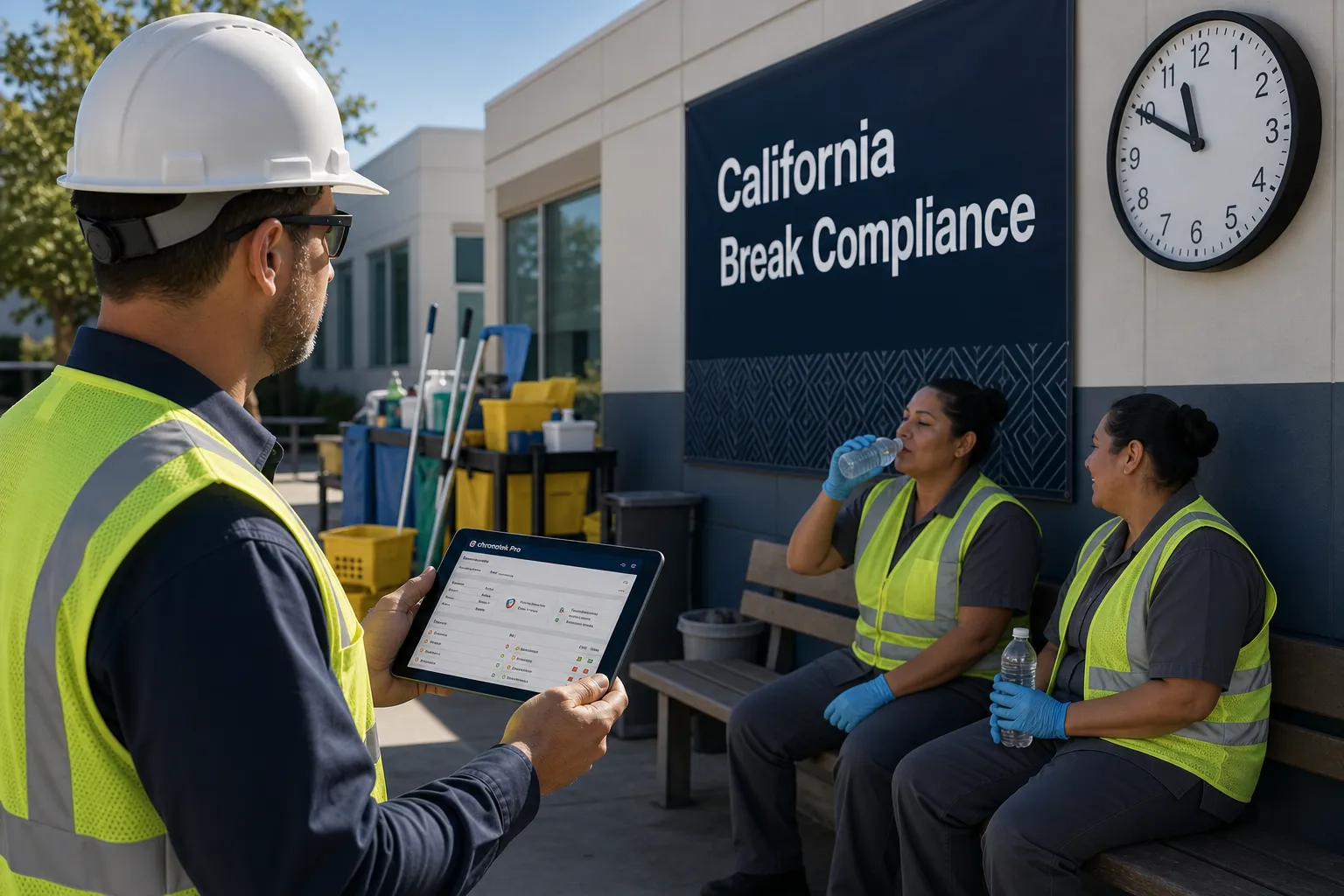

A missed meal break can look small on a timesheet. Across a janitorial, security, construction, or facilities workforce, it can quickly become a payroll exception, a wage claim, and an avoidable operating cost. California meal and rest break compliance requires more than putting a policy in an employee handbook. It requires schedules, supervisors, time records, and field communication that make lawful breaks practical at every job site.
Chronotek Pro now helps California employers put that process into operation. Its California meal and rest break compliance features can remind employees when breaks are due, detect potential late, short, or missed breaks, collect the facts needed for review, and guide managers through remediation before an exception disappears into payroll. The goal is not to replace legal advice or sound management. It is to give distributed-workforce employers the visibility and workflow they need to manage California's complicated break requirements consistently.
For employers managing dispersed hourly teams, the pressure points are familiar. A cleaner is finishing a late turnover. A guard cannot leave an uncovered post. A crew is moving between locations. When work is not planned around breaks, managers often discover the problem after payroll closes. By then, an operational decision has become a compliance issue.
What California Meal Break Compliance Requires
California generally requires a 30-minute unpaid, off-duty meal period when a nonexempt employee works more than five hours in a workday. The first meal period must begin no later than the end of the employee's fifth hour of work. For example, an employee who starts at 8:00 a.m. should begin the first meal period by 1:00 p.m. at the latest.
If an employee works more than 10 hours, a second 30-minute meal period is generally required. That second meal period must begin no later than the end of the employee's 10th hour of work.
A first meal period may be waived by mutual consent only when the employee's total work period is no more than six hours. A second meal period may be waived when the total work period is no more than 12 hours and the first meal period was not waived. These are narrow conditions, not a scheduling shortcut. Employers should document valid waivers and apply them only when the legal conditions are met.
The meal period must be duty-free. Employees must be relieved of all work responsibilities, released from the employer's control, and given a reasonable opportunity to take an uninterrupted break. A supervisor who expects an employee to monitor a radio, answer calls, watch a site entrance, respond to customer requests, or remain available during an unpaid meal period may create a problem even if the timecard says "meal."
Employers are generally required to provide compliant meal periods, not police how employees use every minute after they have been fully relieved. But the company cannot pressure employees to skip breaks, make breaks impractical, or create work conditions that discourage or prevent employees from taking them. The California Labor Commissioner's meal-period guidance explains these obligations and the applicable timing rules.
On-Duty Meal Periods Are Not a Default Fix
Some field roles create real coverage challenges. A lone security officer at a post or an employee at a remote site may not be easily relieved. California allows an on-duty paid meal period only in limited situations where the nature of the work prevents relief from all duty and the arrangement is documented in a written agreement that the employee may revoke in writing.
This is an exception that deserves careful review with California employment counsel. Calling a meal period "on-duty" because relief coverage is inconvenient is not enough. In many cases, the more reliable solution is to build relief staffing, staggered schedules, or temporary coverage into the operation.
Do Not Overlook Paid Rest Breaks
Meal periods receive much of the attention because they are recorded and often unpaid. Rest periods matter too. California generally requires a paid, duty-free 10-minute rest period for every four hours worked, or major fraction of four hours, insofar as practicable. Rest periods should generally fall near the middle of each work period. A rest period is not ordinarily required when the employee's total daily work time is less than three and one-half hours.
Unlike meal periods, rest periods are typically counted as paid work time and are not commonly recorded as separate punches. That does not mean they can be ignored. Field supervisors need clear instructions not to discourage employees from taking them or assign work demands that make them impossible.
For a seven-and-a-half-hour shift, for instance, an employee will usually be entitled to two paid rest periods and one meal period. Schedules that account only for the meal break can still leave the company exposed. The California Labor Commissioner's rest-period guidance provides additional detail, including rules and exceptions that may apply to particular industries.
Why Field Teams Need an Operational Compliance System
A written policy cannot solve a schedule that leaves one employee alone at a customer location for eight hours. It cannot correct a manager who assigns a task at the exact time a meal period should begin. And it cannot explain whether a missed break resulted from an employee's voluntary choice or a job-site condition the company could have addressed.
California meal break compliance becomes harder when teams work across dozens of sites because each shift has its own variables: arrival delays, last-minute callouts, customer access restrictions, travel time, emergency coverage, and changing workload. Managers need visibility while there is still time to act—not a stack of unexplained exceptions after the fact.
Chronotek Pro's California meal and rest break software connects the employee's schedule, actual work time, break activity, and compliance status in one operational workflow. It can help employers:
- Remind employees when meal and rest periods are approaching so they can act before a deadline is missed.
- Detect potential late, short, or missed meal periods from actual shift and break activity.
- Identify when a second meal period or additional rest periods may be required as a shift extends.
- Apply employer-configured break rules and waiver conditions consistently.
- Warn employees when ending a meal period too soon could create a short-meal exception.
- Ask end-of-shift questions and capture the employee's explanation when a required break may not have been provided.
- Surface exceptions for manager review instead of allowing them to remain buried in a timecard.
- Preserve a clearer audit trail of reminders, responses, exceptions, and follow-up actions.
- Support a documented remediation process when a review determines that premium pay or another correction is appropriate.
This is a meaningful change from ordinary timekeeping. A basic system records what an employee punches. Chronotek Pro helps managers recognize what those punches may mean under California break rules and gives them a process for responding.
Chronotek Pro does not determine an employer's legal obligations, replace legal counsel, or guarantee compliance. It gives employers practical controls to help apply their policies, detect potential violations, document what happened, and take timely corrective action.
Build Break Compliance Into the Schedule
The most effective control starts before employees clock in. Schedule the first meal period with a real deadline in mind, not as a vague instruction to "take lunch sometime." For an eight-hour evening cleaning shift that begins at 5:00 p.m., plan coverage so the employee can begin the meal period by 10:00 p.m. at the latest.
For jobs with fixed customer-service windows, stagger employees so one person can cover essential work while another takes a break. For single-employee posts, identify relief coverage before the shift begins. If no relief exists, the assignment itself may need to be redesigned.
Managers should also account for work performed before and after the main job-site shift. Travel between assignments, loading supplies, responding to client requests, and completing required reporting can extend the workday. A timecard that shows an eight-hour scheduled shift may not reflect the actual work period used to determine meal and rest break requirements.
Chronotek Pro can use actual shift activity—not just the original schedule—to help surface changing break obligations. If a shift runs long, managers need to know that the extension may trigger another meal or rest period before the employee clocks out.
Use Time Records That Show What Happened
Reliable records are both a compliance control and an operational tool. For nonexempt employees, timekeeping processes should accurately capture work time and meal-period start and end times. Automatic meal deductions are especially risky when they deduct 30 minutes regardless of whether the employee actually received an uninterrupted, duty-free meal period.
If an employee misses, shortens, or takes a late meal period, the process should make that exception visible. An attestation or exception question can help gather context, including whether workload, lack of relief, supervisor instruction, an unexpected service issue, or the employee's own choice affected the break. The answer should trigger review, not blame.
Chronotek Pro's California compliance workflow is designed for that moment. The system can flag the potential violation, gather the employee's response, and give the appropriate manager a documented exception to investigate. Instead of reconstructing events days later from memory, employers have a more complete record of the shift and a clearer path toward resolution.
The operational value goes beyond an individual timecard. Recurring exceptions can reveal which locations, shifts, supervisors, or staffing patterns repeatedly put breaks at risk. That information helps management correct the underlying cause instead of paying for the same preventable problem over and over.
Detecting a Violation Is Only the First Step
Alerts are useful only when they lead to action. A strong remediation process should help the reviewer answer four questions:
- What does the time record show?
- Was the employee provided a compliant break and fully relieved of duty?
- What caused the late, short, or missed break?
- Does the company's policy or legal review call for premium pay, a timecard correction, coaching, a scheduling change, or another response?
Chronotek Pro helps organize this review by bringing the break exception, employee response, shift details, and follow-up into a consistent workflow. Managers can address the immediate event while operations leaders use exception patterns to improve relief coverage, staffing, training, and account budgets.
That distinction matters. Compliance is not achieved simply by generating an alert. Employers need to review potential violations promptly, document their decisions, complete any required remediation, and reduce the chance that the same operating condition will cause another exception.
Handle Meal and Rest Premiums Promptly
When an employer does not provide a compliant meal period, California generally requires one additional hour of pay at the employee's regular rate of compensation for that workday. A separate additional hour may be owed when a compliant rest period was not provided. Depending on the circumstances, exposure can therefore reach two hours of premium pay in one workday: one for meal-period violations and one for rest-period violations.
Premium pay is not simply another overtime calculation. The correct regular rate of compensation can involve more than the employee's base hourly rate, particularly when nondiscretionary bonuses or other compensation apply. Payroll and HR teams should have a defined process for reviewing exceptions, calculating any premium correctly, and paying it in the appropriate pay period. California Labor Code section 226.7 contains the statutory premium-pay requirement.
Do not wait for an employee complaint to investigate repeated late or missed breaks. A pattern at one account may reveal an understaffed contract, an unrealistic labor budget, or a supervisor who needs clearer scheduling guidance. That is useful information for both compliance and profitability.
Chronotek Pro helps move potential violations into view early enough for payroll and operations to respond. Its remediation workflow helps employers document the review and track the follow-up rather than relying on email chains, paper forms, or a manager's memory.
Train Supervisors on the Decisions That Matter
Frontline supervisors often determine whether a break is truly available. They need practical direction, not just a copy of the policy. Train them to:
- Plan relief coverage before a shift begins.
- Avoid assigning work during unpaid meal periods.
- Escalate coverage gaps early.
- Respond to Chronotek Pro alerts promptly.
- Document actual exceptions accurately.
They should also understand what not to say. Statements such as "finish this first," "keep your phone on," or "just eat while you work" can undermine a compliant meal period. The same applies to informal expectations that employees should skip breaks to keep a customer happy or finish a job under budget.
Alerts and attestations cannot repair a culture that discourages breaks. Technology works best when employees understand their rights, supervisors know how to arrange coverage, managers investigate exceptions fairly, and payroll has a reliable process for remediation.
Some California wage orders, collective bargaining agreements, and industry-specific circumstances can affect how break rules apply. Because the consequences can be significant, employers should have California employment counsel review their policies, waiver forms, on-duty meal agreements, premium-pay procedures, and Chronotek Pro configuration.
Turn California Break Compliance Into a Manageable Process
California's meal and rest break rules are complicated, but the daily management process does not have to depend on guesswork. Chronotek Pro helps employers move from a reactive process to a practical compliance workflow:
- Plan shifts and relief coverage around actual break deadlines.
- Remind employees before required breaks are at risk.
- Detect potential late, short, or missed breaks.
- Gather employee input while the details are still fresh.
- Route exceptions to managers for timely review.
- Document remediation and reveal recurring operational causes.
The strongest approach is to make breaks part of how work gets planned, staffed, monitored, and reviewed. When schedules support the field team and potential violations are detected early, employers gain better records, fewer surprises, and a clearer opportunity to correct problems before they become recurring payroll or legal exposure.
Chronotek Pro now gives California-based companies the tools to do exactly that. Explore Chronotek Pro's California compliance workflow to see how meal and rest break violation detection and remediation can fit into your operation.
This article provides general information and is not legal advice. California break requirements vary by employee classification, wage order, industry, collective bargaining agreement, and other circumstances. Consult qualified California employment counsel about your company's specific obligations.
Frequently Asked Questions
How many hours can you work in California before you get a lunch break?
California generally requires a 30-minute unpaid, off-duty meal period when a nonexempt employee works more than five hours in a workday. The first meal period must begin no later than the end of the employee's fifth hour of work - for example, an employee who starts at 8:00 a.m. should begin the first meal period by 1:00 p.m. at the latest. This is general information, not legal advice; consult qualified California employment counsel about your specific obligations.
Do I get a second meal break if I work more than 10 hours in California?
Yes. If an employee works more than 10 hours, a second 30-minute meal period is generally required, and it must begin no later than the end of the employee's 10th hour of work. A second meal period may be waived only when the total work period is no more than 12 hours and the first meal period was not waived - narrow conditions, not a scheduling shortcut.
Can a California employee waive their meal break?
A first meal period may be waived by mutual consent only when the employee's total work period is no more than six hours. A second meal period may be waived when the total work period is no more than 12 hours and the first meal period was not waived. These are narrow legal conditions, and employers should document valid waivers and apply them only when the conditions are actually met.
How many paid rest breaks am I entitled to in California?
California generally requires a paid, duty-free 10-minute rest period for every four hours worked, or major fraction of four hours, insofar as practicable, and rest periods should generally fall near the middle of each work period. A rest period is not ordinarily required when total daily work time is less than three and one-half hours. For a seven-and-a-half-hour shift, an employee will usually be entitled to two paid rest periods and one meal period.
What happens if my employer doesn't provide a compliant meal or rest break?
When a compliant meal period is not provided, California generally requires one additional hour of pay at the employee's regular rate of compensation for that workday. A separate additional hour may be owed when a compliant rest period was not provided, so exposure can reach two hours of premium pay in one workday. Payroll and HR teams should have a defined process for reviewing exceptions and calculating any premium correctly.
Can an employee work through their meal break in California?
Generally, no. The meal period must be duty-free - employees must be relieved of all work responsibilities, released from the employer's control, and given a reasonable opportunity to take an uninterrupted break. On-duty paid meal periods are allowed only in limited situations where the nature of the work prevents relief from all duty and a written, revocable agreement is in place; that is an exception to review carefully, not a default fix for coverage gaps.