


Janitorial job costing software tracks the actual labor hours and labor dollars your cleaners put into each contract, then compares those real costs against the budget you bid — so you know whether every account is making money or quietly losing it. That is a different job than estimating software, which helps you build the quote in the first place. And here is the uncomfortable truth behind most searches for janitorial estimating software: the estimate is rarely where cleaning bids go wrong. Bids go wrong because the company does not know its true loaded cost per labor hour, and because nobody tracks the actual hours a contract consumes after the work starts. Those are pricing and tracking problems, and this guide covers how to solve both — plus straight answers on the related searches for work order and equipment software.
What is janitorial job costing software?
Job costing software answers one question per account: are we making money on this contract? To answer it, the system needs two inputs. First, verified hours — who worked each job, when, and for how long, confirmed at the job site rather than copied from a handwritten timesheet. Second, real labor rates — what each of those hours actually costs you once payroll taxes, workers' comp, and overhead are loaded on top of the wage.
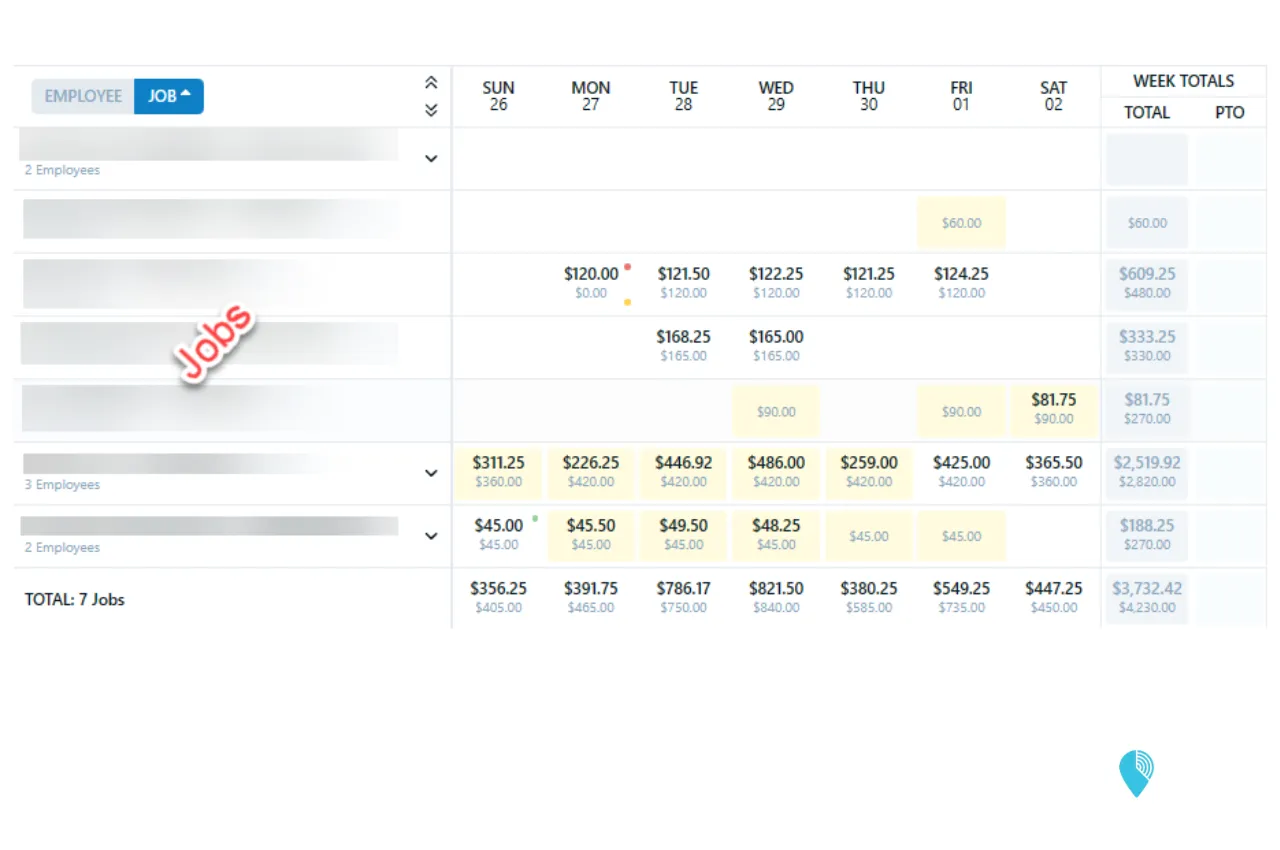
With those inputs, job costing software can show live labor dollars flowing against each job's budget, highlight overtime and travel time by job, and flag the accounts drifting over plan while there is still time to fix the schedule. Chronotek Pro goes a step further by aligning budgets with schedules, so you can see predicted labor costs weeks and months ahead — including future overtime and travel before they happen — and spot an unprofitable contract before renewal time instead of after.
The foundation underneath all of it is accurate time data — if cleaners can clock in from home, pad a paper timecard, or get logged against the wrong account, the costing math is fiction. That is why job costing works best on top of janitorial time tracking software that verifies clock-ins at the site.
Why cleaning contracts lose money
Cleaning contracts rarely fail in one dramatic event. They bleed. The two most common leaks are unverified hours and an unknown loaded labor rate.
Unverified hours means you are paying for labor you cannot confirm. A shift that runs fifteen minutes long every night, a cleaner clocked in from the parking lot, hours recorded against the wrong account — each leak is small, but a recurring contract multiplies it by five nights a week, fifty-two weeks a year, and the fixed contract price means every extra labor dollar comes straight out of margin.
An unknown loaded labor rate is the quieter problem. Many cleaning companies bid off the bare wage — but employer payroll taxes, unemployment taxes, workers' compensation, insurance, and overhead all ride on top of every hour worked. A bid built on the bare wage is missing those costs on every single hour, and the gap scales with every contract you win. The margin looked fine on paper; the paper just left out part of the cost.
Both leaks share a root cause: delayed visibility. If your first real look at a contract's labor cost is a payroll report or a year-end P&L, the money is already gone. Real-time labor cost tracking exists to close that gap — our guide to field service labor cost tracking covers why after-the-fact accounting reports are not enough.
How to price a janitorial contract: start with your loaded labor rate
Before any bidding formula or production-rate chart matters, you need one number: what an hour of your labor truly costs. The general math looks like this:
- Base wage — what the cleaner earns per hour.
- Employer payroll taxes — the employer share of FICA and Medicare (7.65%), plus federal and state unemployment taxes.
- Workers' compensation — a percentage of wages that varies by state and job classification. Take the rate from your own policy; there is no honest universal number.
- Overhead — insurance, supplies, equipment, office costs, and management time, spread across billable hours.
Add those together and you have your loaded labor rate — the real cost of one hour of cleaning work. From there, pricing a contract is straightforward in principle: estimate the hours the scope of work requires, multiply by the loaded rate, and add the margin you intend to earn. Skip the loading step and your "margin" is partly an illusion.
You do not need to buy software to run this math. Our free labor cost calculator takes a base wage, payroll taxes, your workers' comp rate, and overhead, and returns the loaded hourly cost — use it on every wage tier in your bid before you quote a price.
Job costing vs. estimating software: which do you need?
Estimating software helps you build the quote: workloading a building from square footage and production rates, generating a proposal, tracking the pipeline. Job costing software tells you whether the quote was right once the work starts. They answer different questions, and it is worth being clear about which one your business is missing.
To be equally clear about what we sell: Chronotek Pro is not estimating or quoting software. It does not generate proposals or workload a building for you. You can build your estimate in a dedicated bidding tool or in a spreadsheet — plenty of profitable cleaning companies do the latter. What Chronotek Pro does is everything after the handshake: real-time job costing with custom budgets per job and customer, loaded pay rates and a revenue overhead percentage built into each budget, gross profit tracking, overtime and travel highlighted by job, and predicted costs months ahead as schedules change.
Here is why that order matters. An estimate is a guess — an educated one, but a guess. Job costing turns each contract into recorded fact: this building takes this many verified hours at this loaded cost. After a few months of real data, your next bid is built on your own crews' actual performance instead of a production-rate table from a manual. That feedback loop — bid, measure, re-bid smarter — is how estimating accuracy actually improves. If you only have budget for one tool, most cleaning companies get further with job costing plus a free calculator than with estimating software plus no cost tracking.
What about janitorial work order and equipment software?
Two neighboring searches deserve straight answers.
Work order software. Chronotek Pro is not work order software — there is no module for creating dispatchable work orders, running inspections, or invoicing from tickets. But look at what most janitorial companies actually mean by "work orders": recurring assignments, at specific sites, with instructions the crew must follow. That is scheduling. Chronotek Pro's janitorial management software handles it with recurring shifts assigned to jobs and teams, job instructions and details attached where crews clock in, late and no-show alerts when a scheduled shift does not start, and actual-versus-scheduled hours on every job. If your "work orders" are recurring cleaning assignments rather than one-off dispatch tickets, a schedule with instructions and verification covers the need.
Equipment software. Chronotek Pro is not asset-maintenance software; it does not schedule machine servicing or track depreciation. What it does track is supplies and inventory: stock levels at every warehouse and job site, threshold alerts before you run out, supply requests cleaners send from the same app they clock in with, supervisor approvals, and delivery tracking to the site. For most cleaning operations, the daily "equipment and supplies" problem is knowing what is at each site and never running out mid-shift — exactly what supply management covers.
Frequently Asked Questions
What is the best job costing software for janitorial companies?
The best job costing software for a janitorial company is one that starts from verified, on-site clock-ins and shows labor cost against budget per contract in real time — not an accounting tool that assigns hours to job codes after the month closes. Look for loaded pay rates in the budget math, overtime and travel broken out by job, and predicted future costs as schedules change. Chronotek Pro's job costing does all of this on top of GPS-verified timekeeping built for cleaning crews.
Do I need janitorial estimating software to bid cleaning contracts?
No — you can bid accurately from a spreadsheet if you know two numbers: your loaded labor cost per hour and the realistic hours the scope requires. Dedicated estimating tools speed up workloading and proposals, but they cannot fix a bid built on the bare wage or unverified hour assumptions. Get the loaded rate right first with a free labor cost calculator, then track actual hours against the bid so your next estimate is built on real data.
How do I calculate a loaded labor rate for a cleaning bid?
Start with the base wage and add the employer share of payroll taxes (7.65% for FICA and Medicare), federal and state unemployment taxes, your workers' compensation rate, and an overhead allocation per hour. The sum is what one hour of cleaning labor truly costs you — the number your bid should be built on. Workers' comp varies by state and job classification, so pull the rate from your own policy rather than an industry average.
What is janitorial work order software, and does Chronotek Pro replace it?
Janitorial work order software creates and dispatches task tickets, often with inspections and invoicing attached — and Chronotek Pro is not that. What it offers instead covers the recurring core of the job: scheduled shifts assigned to jobs and teams, job instructions attached where crews clock in, and alerts when a scheduled shift does not start. Companies whose "work orders" are recurring cleaning assignments usually find the schedule-plus-instructions model covers the need.
Is there software to track janitorial supplies and equipment?
Yes. Chronotek Pro's supply management tracks inventory at every warehouse and job site, alerts you when an item hits its minimum threshold, and lets cleaners request supplies from the mobile app with supervisor approval and delivery tracking to the site. It is inventory and consumables tracking, not asset-maintenance software — it will not schedule machine servicing, but it will make sure no site runs out of what it needs.
How much does janitorial job costing software cost?
Chronotek Pro — which includes job costing along with timekeeping, scheduling, and supply management — costs $19 per month plus $6 per employee per month, with a 5-employee minimum, so entry pricing is $49 per month. Prepaying annually saves 15%, and every account starts with a 30-day free trial. See current pricing for full details.